
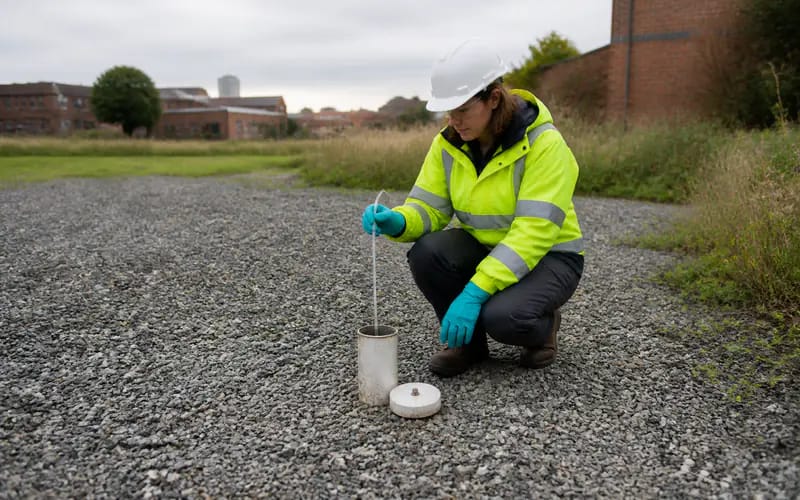
It’s not always obvious what work will be required for Groundwater Testing at a site and it can be surprising how much work is involved before any drilling takes place with a rig.
Desk Study And Site Walkover
First, the consultant conducts a site walkover survey. This involves assessing past and present usage of the site, and understanding the local geology. The consultant can then assess where any contamination is likely to have occurred and assess how deep it is likely to penetrate the ground. The wells can then be positioned to allow the most suitable samples to be taken, and an estimate made as to the depth at which the samples are likely to be taken.
Installing The Monitoring Wells
To prevent contamination of the sample by rainwater or surface run-off the space around the outside of the well casing above the well screen is filled with bentonite or grout. Water flowing into the well through the well screen comes from the aquifer and not from within the well itself. If the well is left unused for weeks then the water within the well can stagnate and become contaminated with the material of the well casing.
Purging The Well Before Sampling
The water in the well casing is not the same as the water in the surrounding ground. It can pick up characteristics from the well casing or it can stagnate in the well for weeks. Therefore, the water in the well casing has to be removed prior to sampling. This water is called “purge water” and it is typically discarded until the field parameters, such as conductivity and temperature, have reached a stable value and are no longer changing. This indicates that fresh water from the aquifer has taken the place of the stagnant water in the well casing.
Taking The Sample
The sampling of groundwater is normally taken using low-flow sampling techniques to prevent the resuspension of sediment at the bottom of the well. All sampling is undertaken using dedicated bailers or sampling pumps which are either specifically dedicated to that well or thoroughly cleaned between each well to prevent cross-contamination. In addition, the sample bottles are specific to the test(s) being carried out and certain preservatives/bottle types can react with certain samples.
Field Readings Taken On Site
Other parameters of the sample such as pH, temperature, conductivity, dissolved oxygen and redox potential must be recorded at the wellhead as these parameters start to change immediately after the sample has been taken from the groundwater and exposed to the atmosphere. These readings are taken using flow cells or probes which are left in the well until the sampling has been completed and the equipment has been packed away.
Laboratory Analysis
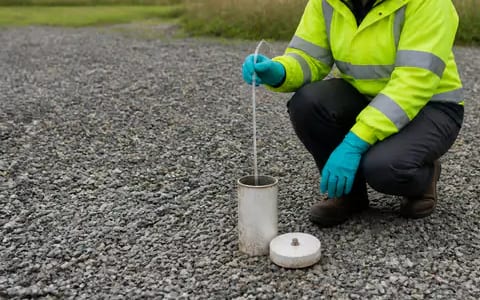
Following the collection of the sample it is sent to an accredited laboratory. The majority of groundwater samples are analysed within 1 to 2 weeks and the results returned to the client. Some laboratories are able to provide results within 24 hours for an additional charge. The types of analysis carried out on a groundwater sample will depend upon the previous use of the site and the results of any previous groundwater samples.
Measuring Groundwater Levels Across The Site
Depth to water is also recorded in all of the wells throughout the site. This is done using a dip meter which is dropped down the borehole. The results from all of the wells are then compared to determine the flow of groundwater and the gradient of the water. The gradient is an important parameter and can vary greatly depending on the type of ground and the local aquifer. The groundwater in the UK and its behaviour within different types of ground is well documented by the British Geological Survey (BGS).
What Happens To The Results
The results from the sampling and field measurements are compared against the relevant groundwater quality guideline values for the appropriate land use, such as domestic, commercial or near a watercourse. If the concentrations of any contaminants have been found to exceed the relevant groundwater quality guideline values then the results from the monitoring wells, flow direction and concentrations of the contaminants of concern can be used to design a Groundwater Remediation strategy as required.
By now you will hopefully have a good idea of what is involved from a site investigation perspective. However, it is also important to understand the results that have been generated in order to get the most from them. More on Groundwater Remediation can be found at https://soilfix.co.uk/services/groundwater-remediation/.
About Author
