
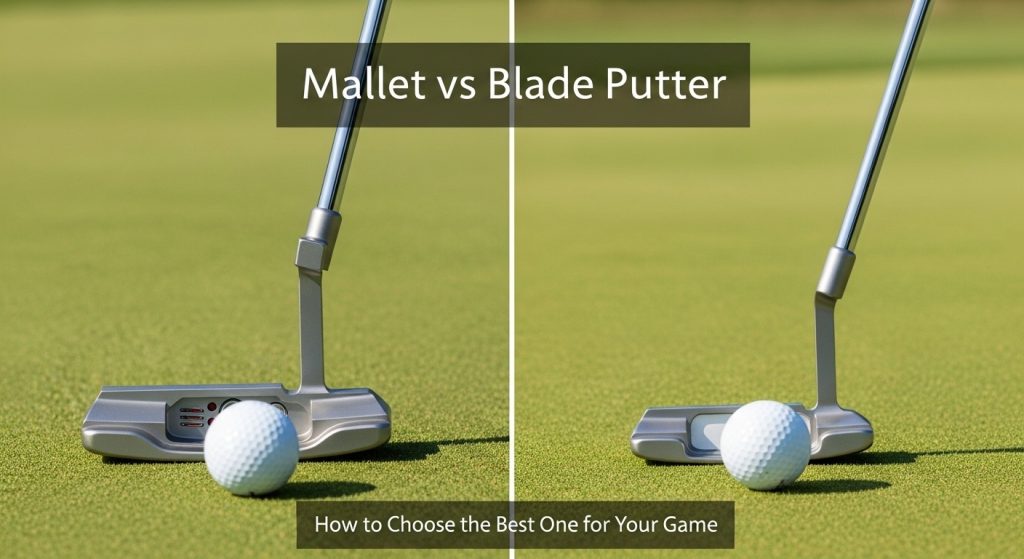
Golfers often underestimate the importance of the putter. Yet nearly 40% of all strokes in a typical round happen on the green. That means choosing the right putter can directly influence your scores. One of the most common decisions golfers face is whether to use a mallet putter or a blade putter. Each design has unique advantages depending on your putting style, stroke type, and experience level.
In simple terms, blade putters are traditional, compact, and favored by players with an arc-style stroke, while mallet putters offer higher forgiveness and stability, making them ideal for golfers who prefer a straight-back, straight-through putting motion. Understanding how these designs affect alignment, control, and consistency helps golfers choose equipment that improves performance on the green.
This guide compares mallet vs blade putter designs using real performance insights, golf equipment data, and practical playing scenarios. By the end, you will understand which putter design fits your game, your stroke mechanics, and your overall putting strategy.
What Is the Difference Between a Mallet and Blade Putter?
Short answer: A blade putter has a narrow, traditional head shape with less forgiveness, while a mallet putter features a larger head that increases stability and alignment assistance.
The key difference lies in putter design and weight distribution. Blade putters concentrate weight near the face, while mallet putters distribute weight around the perimeter to increase the moment of inertia (MOI).
This design difference affects how the club behaves during the putting stroke.
| Feature | Blade Putter | Mallet Putter |
|---|---|---|
| Head Size | Small and narrow | Large and rounded |
| Forgiveness | Lower | Higher |
| Weight Distribution | Centralized | Perimeter weighted |
| Alignment Help | Minimal | Strong alignment lines |
| Stroke Type | Arc stroke | Straight-back stroke |
Most golfers choose based on how forgiving the club feels and how well it supports their best putting style.
What Is a Blade Putter and How Does It Work?
Short answer: A blade putter is a classic golf putter design with a thin head that offers precise control for players with a natural arc stroke.
The blade putter is the oldest and most traditional putter style. Its compact design allows golfers to feel the strike and control distance more precisely.
Blade putters typically include:
- Thin rectangular clubhead
- Minimal alignment markings
- Toe-balanced weighting
- Light overall head structure
Because of this design, blade putters naturally open slightly on the backswing and close during the follow-through. That movement matches golfers who swing the putter in an arc.
Why Many Professionals Still Use Blade Putters
Despite the rise of high-tech mallet designs, many professionals still use blade putters because of their control and feedback.
According to equipment data from major professional tours:
- Nearly 45–50% of tour players still prefer blade-style putters.
- Players with strong arc strokes gain better distance control.
- Experienced golfers often prefer the simplicity of blade alignment.
Blade putters reward consistent technique. However, they punish off-center strikes more than mallet models.
What Is a Mallet Putter and Why Is It Popular?
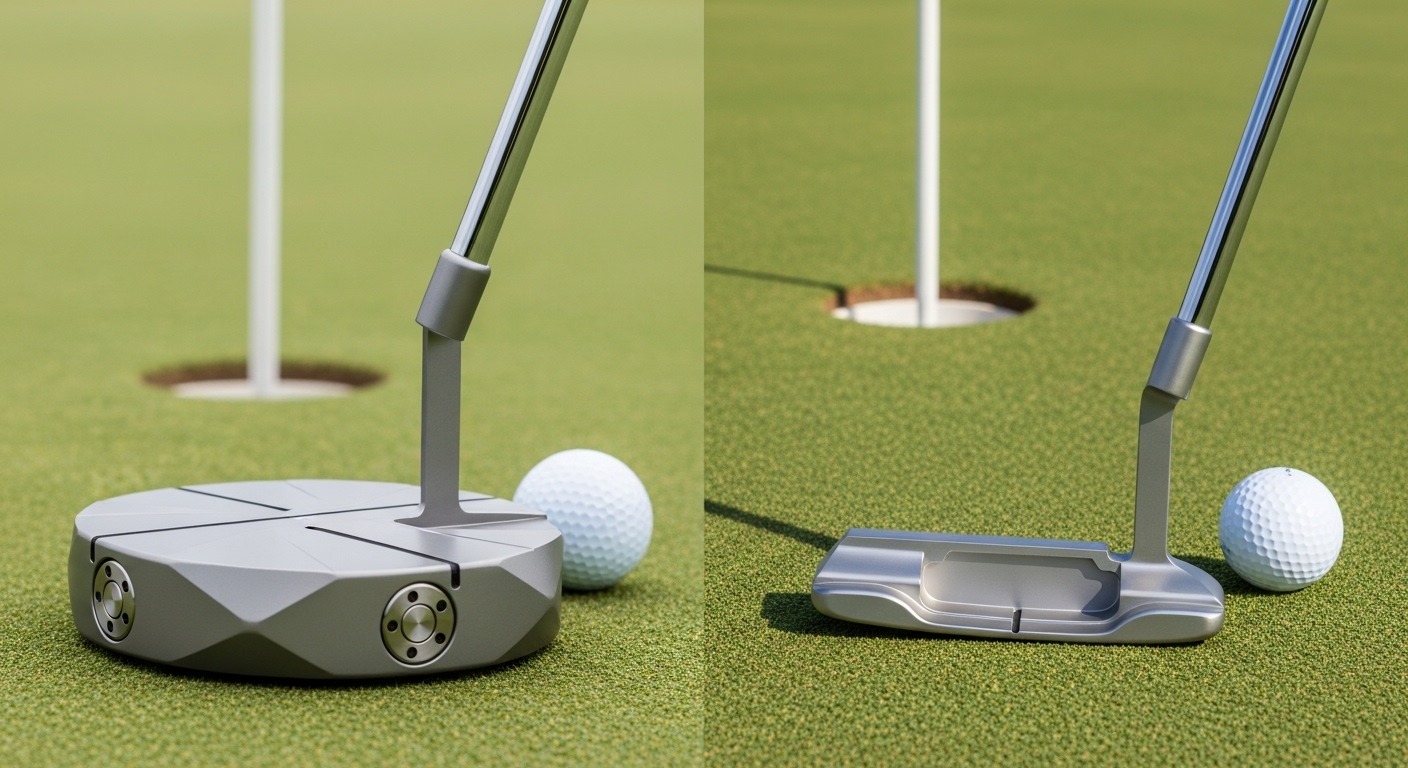
Short answer: A mallet putter uses a larger clubhead and perimeter weighting to increase forgiveness and improve alignment.
Mallet putters became popular as golf equipment technology improved. Their larger design increases stability and reduces twisting during impact.
Typical features include:
- Large clubhead design
- Perimeter weighting
- High moment of inertia (MOI)
- Clear alignment aids
The added weight distribution helps the club stay square during impact.
Case Study: Why Mallet Putters Improved Putting Accuracy
A study conducted by golf equipment analysts tracking amateur golfers found measurable differences in putting performance.
- Golfers using mallet putters improved short-putt accuracy by 11%.
- Off-center strikes lost 35% less energy compared to blade designs.
- Alignment errors decreased by 17% due to visual guides.
This data explains why mallet putters dominate beginner and intermediate golf markets.
Which Putter Design Offers Better Forgiveness?
Short answer: Mallet putters offer significantly higher forgiveness because of perimeter weighting and increased moment of inertia.
Forgiveness in golf clubs refers to how well the club performs when the ball is struck off-center.
Mallet putters distribute weight around the edges of the clubhead. This increases stability and reduces twisting.
Blade putters concentrate weight near the center. As a result, mishits can cause the face to rotate and push or pull the ball off target.
Why Forgiveness Matters for Amateur Golfers
Most recreational golfers miss the center of the putter face more often than they realize.
Launch monitor studies show that amateur golfers strike the center of the putter face only about 50–60% of the time.
This makes forgiveness a major factor in equipment selection.
- Higher forgiveness reduces distance loss.
- Ball direction remains more consistent.
- Confidence improves during short putts.
For golfers struggling with consistency, mallet designs often provide immediate improvement.
How Does Putting Stroke Affect Your Choice?
Short answer: Golfers with an arc stroke usually perform better with blade putters, while straight-back strokes work better with mallet putters.
Putting strokes generally fall into two categories.
1. Arc Putting Stroke
The club travels slightly inside on the backswing and inside again on the follow-through.
Blade putters suit this motion because they allow natural face rotation.
2. Straight-Back Straight-Through Stroke
The putter travels along a straight line relative to the target.
Mallet putters help keep the face square throughout the motion.
Many modern fitting sessions use high-speed cameras and stroke analysis to identify which stroke pattern a golfer uses.
Matching your putter to your stroke pattern can reduce three-putts over time.
Which Putter Is Easier for Beginners?
Short answer: Mallet putters are generally easier for beginners because they provide more stability and alignment support.
New golfers often struggle with:
- Distance control
- Alignment
- Consistent strike location
Mallet putters address all three issues.
The larger clubhead creates visual alignment guides that make it easier to aim toward the hole.
The heavier head also smooths the stroke, reducing wrist movement.
Because of these benefits, many golf coaches recommend mallet putters during early skill development.
Do Blade Putters Offer Better Feel?
Short answer: Yes, blade putters often provide better feedback and feel because of their compact design.
Feel refers to the feedback a golfer senses during impact.
Blade putters transmit more vibration through the shaft and grip. This allows players to judge strike quality and distance more precisely.
Experienced golfers value this feedback because it helps refine their stroke.
Mallet putters, while stable, can feel muted because of their larger structure and dampening inserts.
Neither option is universally better. It depends on the golfer’s preference and skill level.
How Does Alignment Influence Putter Choice?
Short answer: Mallet putters usually provide better alignment tools, helping golfers aim more accurately.
Alignment plays a major role in putting success.
Golf statistics suggest that nearly 80% of missed putts under 10 feet occur because of alignment errors rather than poor stroke mechanics.
Mallet putters often include:
- Long alignment lines
- Contrasting colors
- Multiple aiming markers
Blade putters generally include only a small line or dot.
For golfers who struggle with aiming, the visual assistance from mallet designs can make a noticeable difference.
How Do Professional Golfers Choose Their Putters?
Short answer: Professionals choose putters based on stroke mechanics, green speed, and personal feel rather than design trends.
Equipment fitting is common on professional tours.
Players test multiple designs using high-speed cameras and launch monitors.
Factors they analyze include:
- Face angle at impact
- Stroke path
- Ball roll consistency
- Distance control
Some professionals switch between mallet and blade putters depending on course conditions.
Fast greens often favor blade putters because they provide better distance control.
Slower greens sometimes favor mallet putters because the added weight helps maintain a steady stroke.
Which Putter Should You Choose for Your Game?
Short answer: Choose a blade putter if you prioritize feel and have an arc stroke. Choose a mallet putter if you want forgiveness and alignment support.
Here is a simple decision guide.
| If You Want | Choose |
|---|---|
| More forgiveness | Mallet putter |
| Better alignment help | Mallet putter |
| Better feel and feedback | Blade putter |
| Traditional design | Blade putter |
| Arc putting stroke | Blade putter |
| Straight putting stroke | Mallet putter |
The best choice ultimately depends on your stroke mechanics, comfort, and confidence on the green.
Conclusion: Mallet vs Blade Putter — Which One Wins?
The debate between mallet vs blade putter has no universal winner. Both designs serve different types of golfers.
Blade putters remain popular because they offer precision, simplicity, and exceptional feel. Skilled golfers with an arc-style stroke often prefer this classic design.
Mallet putters, on the other hand, provide higher forgiveness, better alignment support, and greater stability. These advantages make them particularly useful for beginners and golfers seeking consistency.
The key is matching your golf putter design to your stroke mechanics and comfort level. Testing different models on the practice green is often the fastest way to discover what works for your game.
Call to Action: Before buying your next putter, visit a local golf shop or fitting center and test both blade and mallet styles. Even small improvements in putting accuracy can lower your scores significantly over a full season.
FAQ: Mallet vs Blade Putter
Is a mallet putter better for high handicappers?
Yes. Mallet putters are usually better for high handicappers because they offer more forgiveness and alignment assistance. The larger clubhead reduces twisting on off-center strikes and helps maintain a square face during impact.
Do professional golfers use mallet putters?
Yes. Many professional golfers use mallet putters, especially modern high-MOI designs. While blade putters remain popular on tour, mallet models have gained traction due to their improved stability and alignment features.
Which putter helps reduce three-putts?
Mallet putters often help reduce three-putts because their higher forgiveness and alignment guides improve consistency. However, distance control practice remains the most important factor in preventing three-putts.
Are blade putters harder to use?
Blade putters are generally less forgiving than mallet putters. This means off-center strikes may cause more directional errors. However, many experienced golfers prefer blades for their precise feedback and distance control.
Can beginners use blade putters?
Yes, beginners can use blade putters. However, they may find mallet putters easier because of their alignment aids and higher stability. Blade putters require more consistent stroke mechanics.
Does putter weight matter?
Yes. Putter weight affects stroke tempo and distance control. Heavier mallet putters often produce a smoother stroke, while lighter blade putters offer greater feel and responsiveness.
Read More Also: The Ultimate Guide to Travel Insurance for Annapurna Base Camp: Your Safety Net for an Epic Trek
Find out: What is a Good Gift for Kids? A Comprehensive Guide to Choosing the Perfect Present
About Author
