

You spent twenty minutes perfecting a smooth blowout. One step outside into a humid afternoon, and your hair lifts, expands, and twists into a shape you never intended. It is not your imagination, and it is not a sign that your hair is unmanageable. Frizz is a predictable physical response, and understanding the mechanism behind it gives you real control over the outcome. Whether you are fighting summer humidity or just trying to make a style hold in coastal weather, the explanation is rooted in how water interacts with the structure of your hair. Brands like TheBoldCollection have built products around this exact problem, which tells you how universal the frustration is.
Quick Answer
Frizz happens when dry or damaged hair absorbs moisture from humid air. Water molecules push apart the hydrogen bonds that hold your hair’s shape, forcing the cuticle layers to lift and individual strands to swell and bend in different directions. Hair that is already dehydrated, porous, or lacking a protective coating absorbs moisture fastest, which is why the same humidity that leaves one person’s hair flat can turn another person’s hair into a halo of flyaways.
Key Takeaways
- Frizz is caused by moisture absorption, not by humidity acting on the surface of your hair alone.
- Damaged or porous hair absorbs water faster because its cuticle layer is already raised and compromised.
- Humectants in hair products can pull moisture from the air into your hair, which may worsen frizz in high humidity.
- Preventing frizz means either blocking moisture out or ensuring your hair is already balanced with the right amount of moisture before you go outside.
- Silicones, oils, and sealing layers slow moisture absorption but do not repair the underlying porosity.
What Actually Happens to Your Hair in Humidity
Hair is made of three main layers: the medulla (inner core), the cortex (main body), and the cuticle (outer protective layer). The cortex is where most of the structural work happens. It is held together by several types of bonds, including hydrogen bonds, which are weak individually but collectively give your hair its shape and strength. These bonds are constantly responding to water.
When humidity is high, water molecules in the air are attracted to the inside of your hair shaft, especially if the cuticle layer is raised or damaged. As water enters the cortex, it breaks and reforms hydrogen bonds. This causes the hair to swell, change shape, and bend in unpredictable directions. Meanwhile, the cuticle scales, which normally lie flat like shingles on a roof, begin to lift because the swelling underneath pushes them upward. Once the cuticle is raised, the surface is no longer smooth, and individual strands catch on each other instead of gliding together. That is frizz.
Why Some Hair Frizzes More Than Others
Not all hair responds to humidity in the same way. Curly and coily hair has a naturally more open cuticle structure, which means it absorbs moisture more readily. Fine hair has less internal mass to weigh it down, so even slight swelling is visible. Color-treated, heat-styled, or chemically relaxed hair has a compromised cuticle layer that allows water in faster. The common thread is porosity: the more porous your hair is, the faster it takes on moisture and the more dramatic the frizz.
The Role of Hydrogen Bonds in Hair Shape
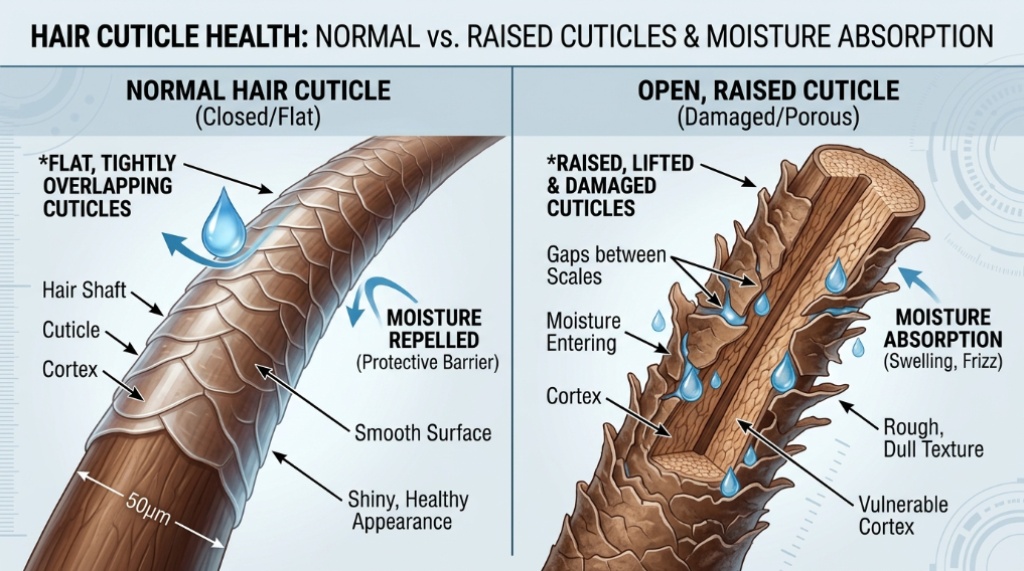
Hydrogen bonds are the reason you can reshape your hair with water alone. If you have ever wet your hair, styled it, and let it dry into a new shape, you have used hydrogen bonds to your advantage. The same mechanism works against you in humid conditions.
When dry hair is exposed to moisture, the hydrogen bonds that were locked into your styled shape begin to break and reform around the water molecules. This is not a gradual process; it can happen within minutes in high humidity. The more water present, the more bonds break, and the more your hair reverts to whatever shape the swelling dictates. That is why a sleek straight style can collapse into waves, and curls can tighten into a tangled, uneven texture.
Humidity, Temperature, and Dew Point: What Actually Matters
Humidity is the most commonly cited culprit, but relative humidity alone does not tell the full story. Relative humidity measures how much moisture the air is holding compared to how much it can hold at a given temperature. Warm air can hold more moisture than cold air. So a 70 percent relative humidity day in cool weather contains less actual water vapor than a 70 percent day in hot weather.
Dew point is often a more useful number. It tells you the actual moisture content in the air. A dew point above roughly 60 degrees Fahrenheit (15.5 degrees Celsius) is generally enough to cause frizz in porous hair. Above 65 degrees Fahrenheit, even relatively healthy hair may start to react. If you want to predict whether your style will survive the day, checking the dew point is more reliable than checking the humidity percentage, To protect your strands from moisture damage and lock in a sleek finish, check out Guide to Shark Hair Dryers Revolutionize Your Hair Care Routine.
How Hair Products Interact with Humidity
Hair products fall into two broad categories when it comes to humidity: those that attract moisture and those that repel it. Understanding which is which helps you choose the right approach for your environment.
Humectants: Helpful or Harmful?
Humectants are ingredients that attract and hold water. Common examples include glycerin, sorbitol, honey, and propylene glycol. In low-humidity conditions, humectants pull moisture from the air into your hair, which can make dry hair feel softer and more hydrated. In high humidity, they can pull too much moisture in, causing the hair to swell and frizz.
This does not mean humectants are always bad. It means they are condition-dependent. If you live in a dry climate, they can be beneficial. If you live in a humid climate, you may need to use them sparingly or pair them with a sealing layer that slows moisture absorption.
Sealants and Occlusives
Sealants create a barrier on the surface of the hair that slows water from entering. Oils like coconut, argan, and jojoba, as well as silicones like dimethicone and cyclopentasiloxane, work this way. They do not repair damage, and they do not stop frizz entirely, but they can reduce how quickly your hair responds to humidity. The trade-off is that heavy sealants can weigh hair down or cause buildup over time if not cleansed properly.
Antihumidity Sprays
Many styling sprays designed for humid conditions use a combination of lightweight silicones, polymers, and sometimes mild humectants to create a flexible film over the hair. This film reduces moisture exchange and helps maintain the style. These products are most effective when applied to dry, styled hair as a finishing step rather than as a primary styling product.
| Product Type | How It Works | Best For | Limitations |
|---|---|---|---|
| Humectant-based leave-in | Attracts water from the air into the hair | Dry climates, low-humidity days | Can worsen frizz in high humidity |
| Oil-based serum | Coats the cuticle and slows moisture entry | Moderate humidity, adding shine | Can weigh down fine hair |
| Silicone-based primer | Forms a flexible film over the hair surface | High humidity, heat styling | Requires thorough cleansing to avoid buildup |
| Antihumidity finishing spray | Creates a lightweight seal over styled hair | Maintaining a finished style outdoors | Not a treatment for underlying porosity |
Why Damaged Hair Frizzes Faster
A healthy cuticle lies flat and tight, forming a nearly continuous barrier. When the cuticle is damaged by heat, chemical processing, rough brushing, or UV exposure, the scales lift and sometimes break off. This exposes the cortex, which is highly absorbent. The result is that damaged hair can take on moisture within minutes of stepping outside, while healthy hair might resist for an hour or more.
If your hair frizzes almost instantly in mild humidity, porosity is likely a bigger factor than the weather itself. In that case, antihumidity products will only mask the problem temporarily. Reducing further damage and improving the condition of the cuticle will have a more lasting effect.
Signs Your Hair Is Highly Porous
- Hair feels dry shortly after washing
- It absorbs water very quickly in the shower
- It takes a long time to dry after washing
- It feels rough or straw-like when you run your fingers up a strand
- Color fades faster than expected
- Frizz appears even in moderate humidity
If several of these sound familiar, the frizz you are experiencing is probably a porosity issue first and a weather issue second.
Practical Strategies to Reduce Frizz in Humidity
There is no single product or trick that eliminates frizz permanently, because frizz is a physical response to moisture. However, you can significantly reduce it by combining several approaches.
- Start with properly hydrated hair. Well-moisturized hair absorbs less external moisture because it is already balanced internally. Use a conditioning routine that matches your hair’s porosity.
- Layer your products correctly. Apply leave-in conditioner to damp hair, follow with a styling product, and finish with a sealing oil or spray once the hair is dry.
- Avoid touching your hair during the day. Every time you run your fingers through your hair, you disrupt the cuticle and create openings for moisture.
- Use a microfiber towel or cotton T-shirt to dry. Regular terry cloth towels roughen the cuticle and increase porosity over time.
- Sleep on satin or silk. These materials create less friction than cotton, which helps preserve the cuticle overnight.
- Check the dew point before styling. If the dew point is above 60 degrees Fahrenheit, plan for a more protective style or use a stronger sealing product.
Common Mistakes That Make Frizz Worse
Many people unintentionally increase frizz while trying to fix it. Here are some of the most common errors:
- Applying oil to dry hair. Oil cannot seal in moisture that is not there. It sits on the surface and can actually attract dust and create a dull appearance.
- Overusing humectants in humid weather. Glycerin-heavy products are popular, but in high humidity they pull water into the hair and accelerate frizz.
- Brushing curly or wavy hair when dry. This separates curl clumps, raises the cuticle, and creates instant frizz.
- Relying on heat styling without protection. Heat damage accumulates over time and increases porosity, making hair more reactive to humidity.
- Washing hair with very hot water. Hot water strips natural oils and lifts the cuticle, leaving hair more vulnerable to moisture absorption.
Frizz and Hair Type: What Changes and What Does Not
The underlying science of frizz is the same for everyone: moisture enters the hair, hydrogen bonds shift, the cuticle lifts, and strands separate. What changes is how visible and how rapid that process is.
Straight hair tends to show frizz as flyaways and a loss of smoothness rather than volume. Wavy hair develops uneven texture and loses definition. Curly hair may tighten, shrink, and become tangled. Coily hair can become dry, rough, and more prone to breakage when the cuticle is raised repeatedly.
The strategies are similar across types, but the product weight and application method should be adjusted. Fine hair needs lightweight sealants; thick or coarse hair can handle heavier oils and creams.
To protect your strands from moisture damage and lock in a sleek finish, check out The Ultimate Guide to Shark Hair Dryers: Revolutionize Your Hair Care Routine.
When Frizz Is a Sign of a Bigger Problem
Occasional frizz in humidity is normal. Constant frizz, even in dry conditions, suggests that your hair’s cuticle is significantly compromised. This can happen from overprocessing, mineral buildup from hard water, or underlying health or nutrition factors. In those cases, no antihumidity spray will solve the problem on its own. A trim to remove split ends, a chelating treatment to remove mineral buildup, and a simplified routine that avoids further damage will do more than any styling product.
Frequently Asked Questions
Does frizz mean my hair is dry?
Not necessarily. Frizz means your hair is absorbing moisture from the air. That can happen because your hair is dry and seeking moisture, or because your cuticle is porous and lets water in easily. Dryness is one common cause, but porosity and damage are equally important factors.
Can I prevent frizz without using products?
You can reduce it by keeping your hair well-conditioned, avoiding rough drying methods, and not touching your hair during the day. However, in high humidity, some form of sealing product is usually necessary to slow moisture absorption, especially for porous hair.
Is glycerin bad for frizz?
Glycerin is a humectant, which means it attracts water. In low humidity, it can help hydrate your hair. In high humidity, it can pull excess moisture from the air and make frizz worse. It is not inherently bad, but it is condition-dependent.
Why does my hair frizz more after coloring?
Coloring raises the cuticle to deposit pigment, which increases porosity. More porous hair absorbs moisture faster, so it frizzes more readily in humidity. Deep conditioning and sealing products can help manage the effect.
Does cutting my hair stop frizz?
Cutting removes damaged ends and can reduce frizz caused by split ends and rough texture. It does not change how your hair responds to humidity at a structural level, but healthier ends generally mean less frizz overall.
What is the best humidity level for hair?
There is no single ideal number, but dew point is more useful than relative humidity. A dew point below 60 degrees Fahrenheit is generally comfortable for most hair types. Above 65 degrees, even healthy hair may begin to frizz.
Conclusion
Frizz is not a random annoyance. It is the predictable result of moisture entering your hair, shifting hydrogen bonds, and lifting the cuticle. The more porous your hair is, the faster and more dramatic that process becomes. You cannot control the weather, but you can control how prepared your hair is for it. Focus on maintaining healthy porosity, layering products correctly, and checking the dew point before you style. With the right routine, humidity becomes a manageable variable instead of an unavoidable problem.
About Author
